 SYBERLABS
RISE
Read beyond the page.
A PASSAGE, PACED
Call me Ishmael. Some years ago, having little or no money in my purse, and nothing particular to interest me on shore, I thought I would sail about a little and see the watery part of the world.
Herman Melville, Moby-Dick
Demo film
RISE demo film
Why
Why a reader, not an app that shows text.
Screens inherited the page from print, so reading software mostly reproduces a page and adds a scrollbar. RISE starts from the other end: a text is a sequence in time, and time can carry pacing, light and sound the way a page carries typography.
The bet is that the conditions around a text change how it is received. RISE is the instrument for testing that bet in a browser, with the reader in control of every condition. What has been shown so far is the instrument, not a measured preference; the project says so on every page.
Use
What you can do today
Five rooms. Everything else is a pane inside one of them.
- 01 / Home
Begin today’s reading
Home names one reading, with its own visual field behind it. Press Begin, or roll another reading.
- 02 / Read
Stream or Page
Words arrive over time at a pace you set, or sit on a page you can navigate. Switch at any point; your place is kept.
- 03 / Library
Curated public-domain texts
Literature, philosophy, poetry and scripture, prepared through an editorial pipeline that tracks edition, structure and rights. The Chapel holds the Douay-Rheims Bible and liturgy paced by a liturgy engine.
- 04 / Make
Compose your own
Workshop, Scriptorium and Visual Lab author audiovisual compositions; the Vault saves them in your browser.
- 05 / Ask
A reading from your own model
Describe what you want to read and a bounded decision model picks a book and presentation from the held catalog. Connect OpenRouter, or run Kev-4B locally; nothing is billed to SyberLabs and nothing leaves your connection.
Rooms
The five rooms, as they open.
Screenshots of a local build of SyberLabs/RISE@998d725 taken on 2026-10-05 in headless Chromium at 1440×900, nothing mocked. The text in every shot is Rural Architecture, from Lyrical Ballads by Wordsworth and Coleridge, a public-domain work served from RISE’s own Library (it was the day’s poem); the fields behind it are RISE’s procedural engines. A silent 25-second screen recording of the same build, Home → Begin → words arriving in Stream (with the few seconds of Preparing session the software renderer needs), is also available; the demo film above remains the edited one. Watch the screen recording (MP4, 25 s, no sound)
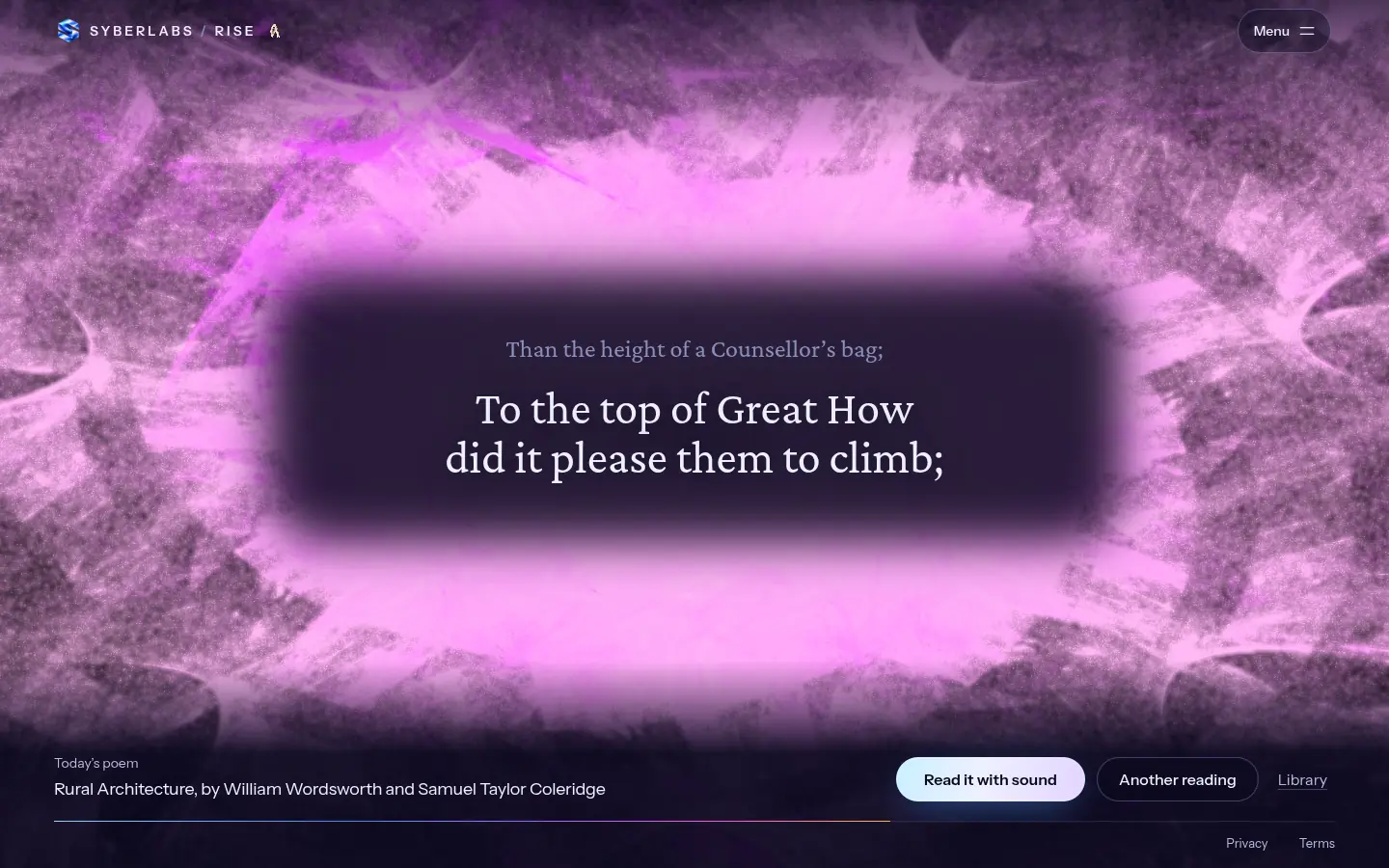
01 / HomeHome as it opens: today’s poem, the public-domain poem Rural Architecture (Wordsworth and Coleridge, Lyrical Ballads) from the Library, already streaming over its own visual field. Local build of SyberLabs/RISE@998d725, 2026-10-05. 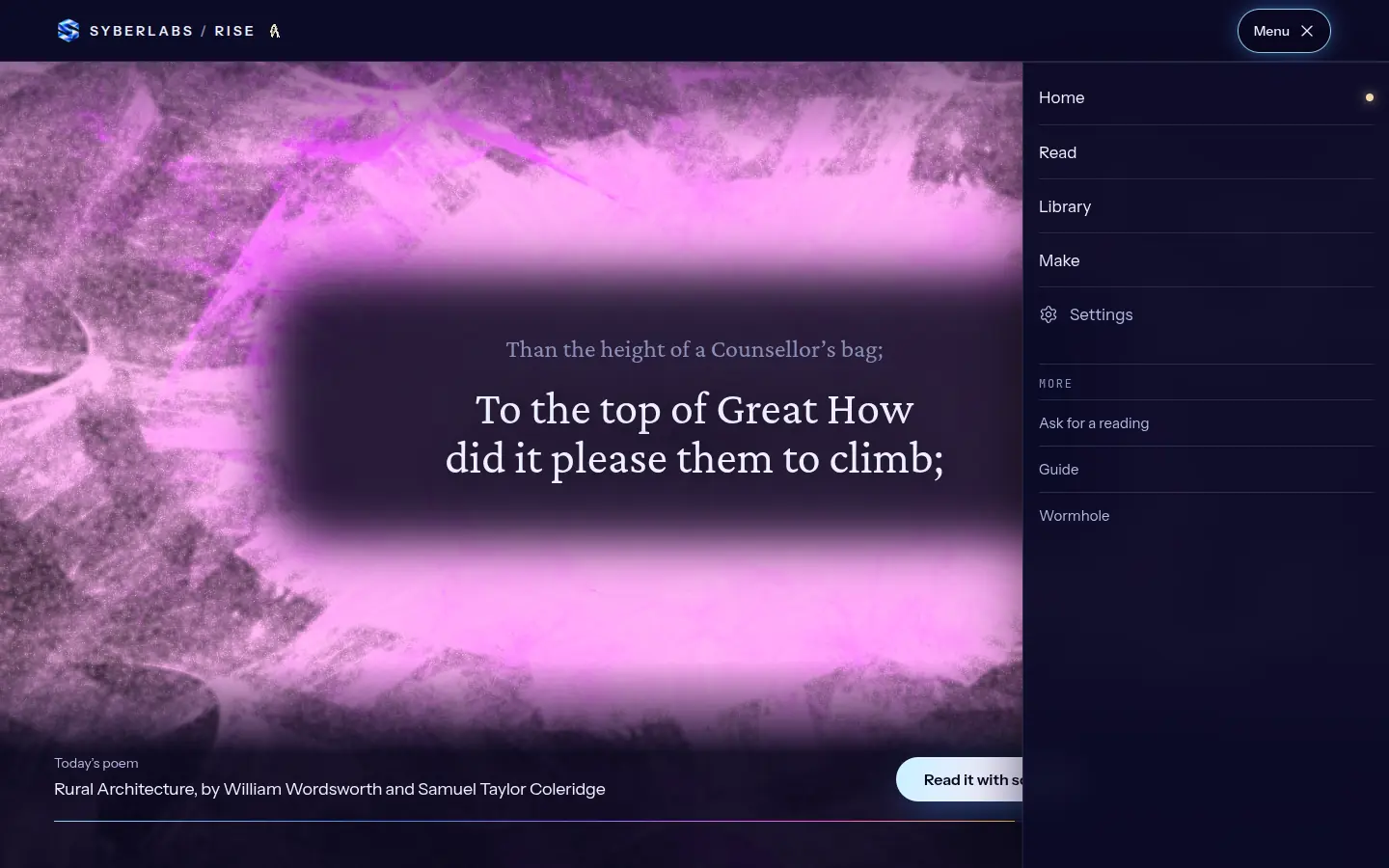
MenuThe Menu, open on Home: the five rooms, Home, Read, Library, Make and Settings, with Ask for a reading, Guide and Wormhole under More. Local build of SyberLabs/RISE@998d725, 2026-10-05. 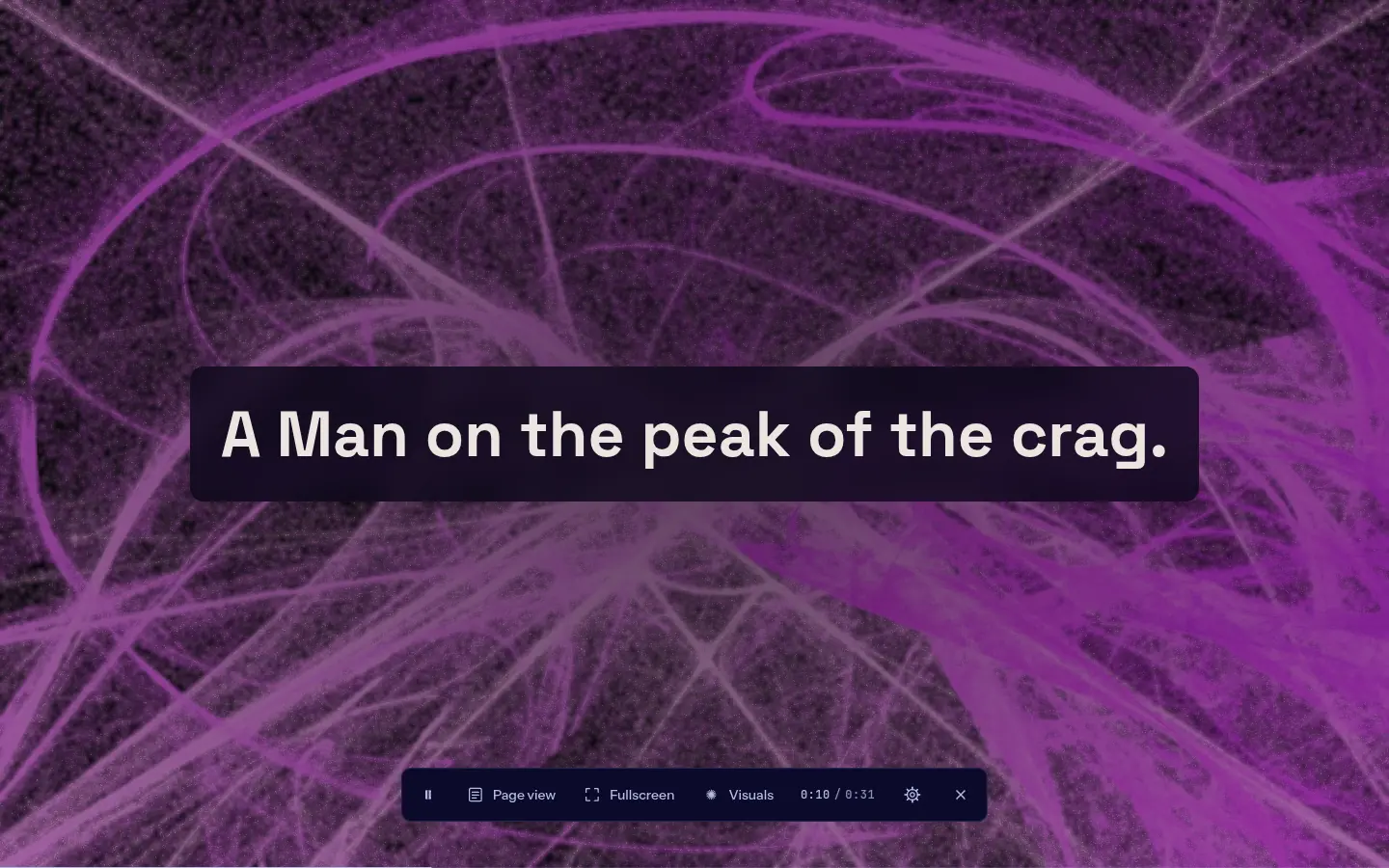
02 / Read · StreamRead, in Stream, ten seconds into a 31-second reading of the public-domain poem Rural Architecture (Wordsworth and Coleridge, Lyrical Ballads) from the Library, with the control bar shown: pause, Page view, fullscreen, Visuals, Settings, end. Local build of SyberLabs/RISE@998d725, 2026-10-05. 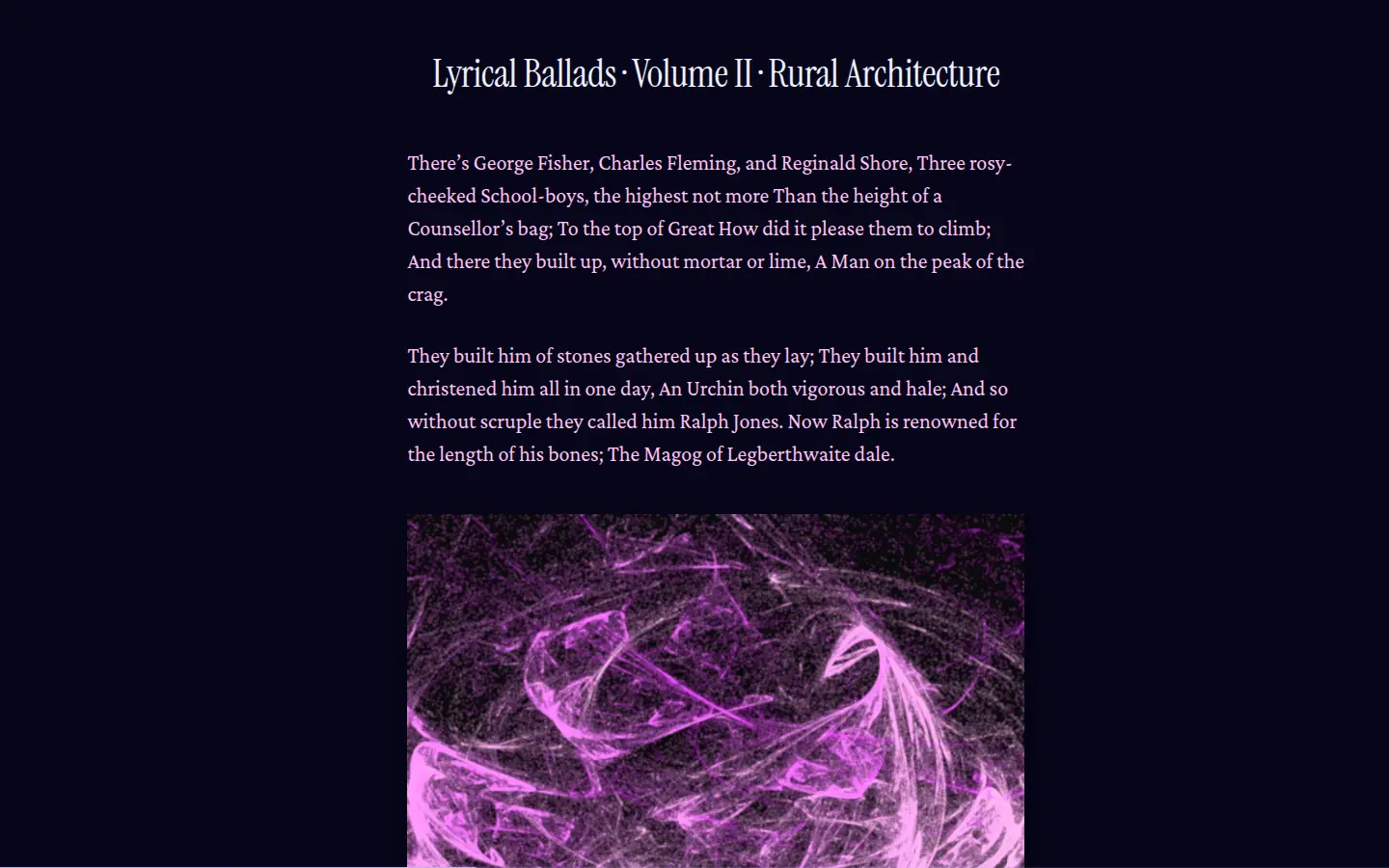
02 / Read · PageRead, switched to Page view mid-reading: the same public-domain poem from the Library set as a page under its edition title, the visual field continuing below. Local build of SyberLabs/RISE@998d725, 2026-10-05. 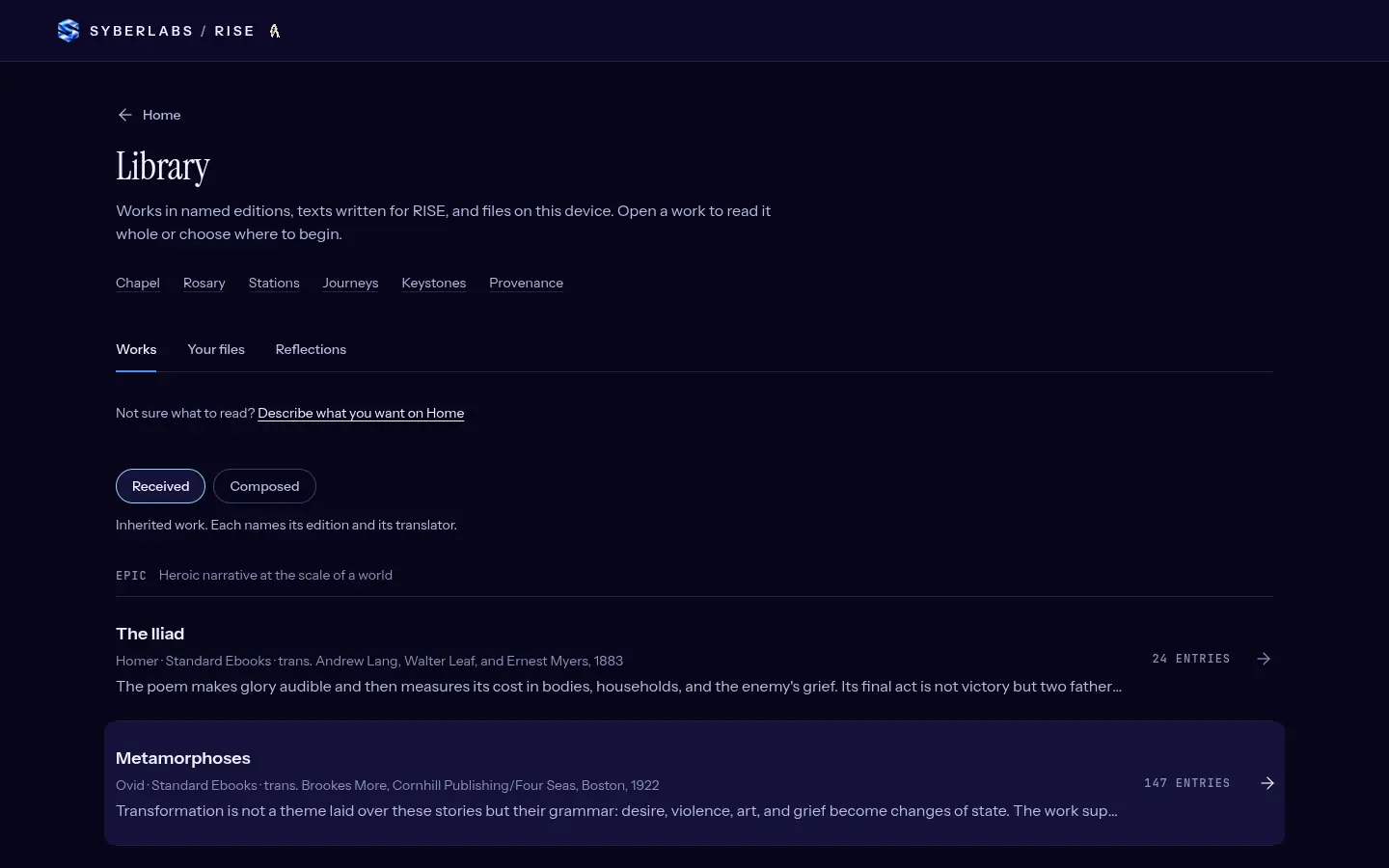
03 / LibraryLibrary: curated public-domain works in named editions (the Epic shelf opens with Standard Ebooks translations of The Iliad and Metamorphoses), with Chapel, Rosary, Stations, Journeys, Keystones and Provenance as panes. Local build of SyberLabs/RISE@998d725, 2026-10-05. 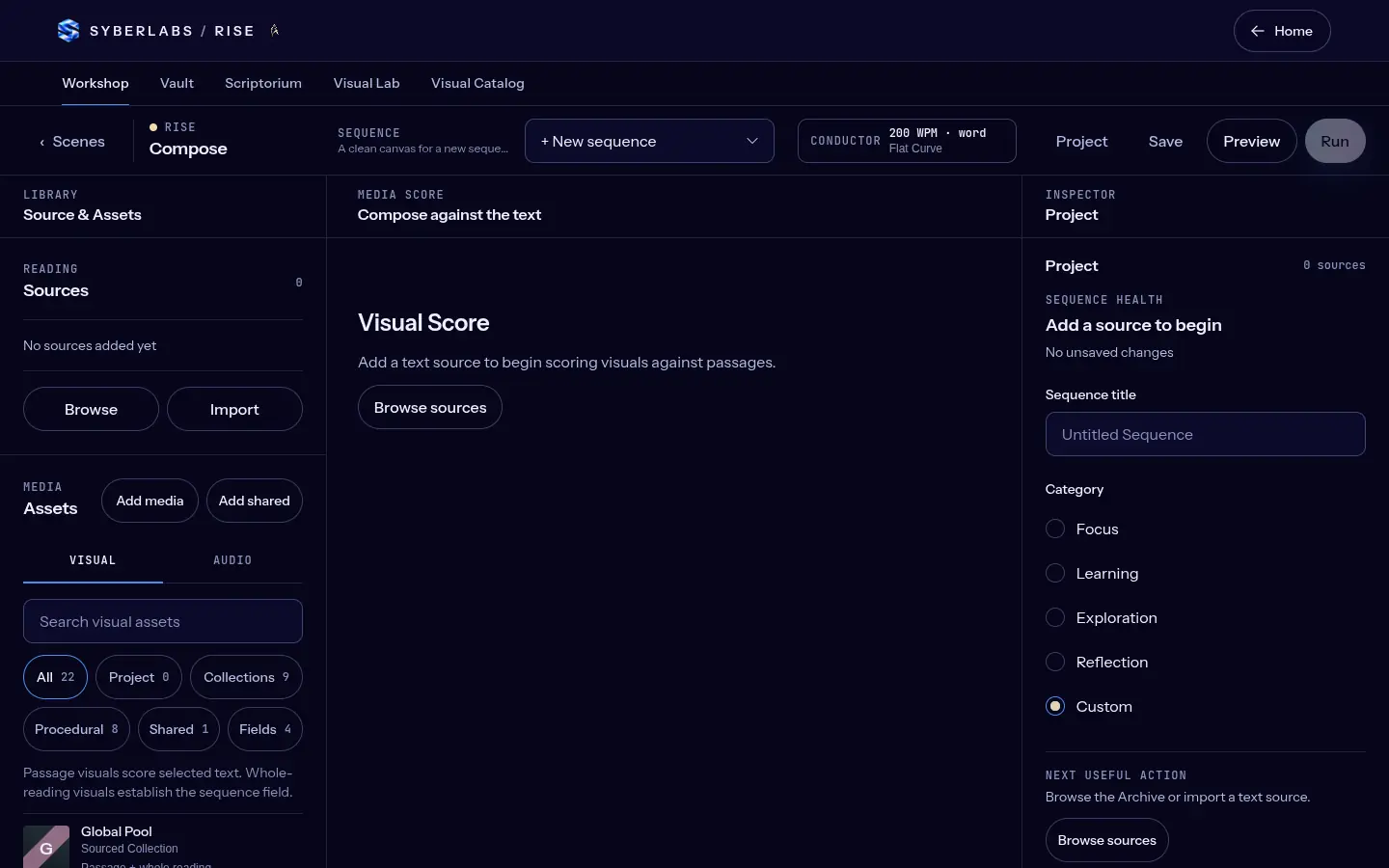
04 / MakeMake, opened from the Menu onto its Workshop pane with Vault, Scriptorium, Visual Lab and Visual Catalog alongside: a new, empty composition; the asset list is the build’s own procedural engines and sourced collections. Local build of SyberLabs/RISE@998d725, 2026-10-05.
Inspect
What a model may choose, and what it may not.
The reader-owned decision contract, stepped through by rule from the code at 998d725: the finite menu, one call on the reader’s own connection, admission of offered keys only, and two refusals that open no reading.
This map needs JavaScript. It steps through RISE’s decision contract: a request, the catalog’s finite questions, a refusal without a connection, one call on the reader’s OpenRouter key or local Kev, a refusal of an unoffered key, and the admitted answer becoming reading settings in the browser.
Design
How it is built
One-way pipeline
Source text → timed units → pacing → compiled session → clock-driven player. The same compiled session drives Stream and Page.
Content-addressed texts
Book text is served as SHA-256-named JSON and verified on every read, which took 15.4 MB out of the JavaScript bundle.
A first-load budget
About 59 KB brotli over three requests, held under a 64 KB budget that CI enforces.
No shared inference
The Cloudflare Worker serves the app and a static decision catalog. It runs no model and holds no model credential; the six former inference routes answer 410.
Composer, in ChatGPT
In ChatGPT, RISE is a Composer: the host model composes one sealed Current in a single tool call, the Worker validates and admits it, and nothing plays until the reader presses Begin. A refused Current never becomes playable.
Tested design contracts
Around 2,800 Vitest unit and integration tests plus Playwright browser tests, a generated architecture diagram, and release gates with artifact verification and rollback.
Evidence
- Deployed
The reader, Library, Chapel, Make rooms and the interactive sample run at rise.syberlabs.io.
- Tested
Unit, integration and browser suites run in CI; the first-load budget and the design diagram are checked on every release.
- Measured
Composer in ChatGPT: a controlled developer-mode session on 2026-10-04 produced an admitted Current and narration the reader confirmed hearing. That is partial acceptance on one release, not a public listing.
- Not yet
RISE Plus voice (an ElevenLabs voice, $8.99 a month) is not available yet. It is built and tested in draft pull requests that are not merged or deployed.
- Not yet
No reader study has been run; release evidence still records zero real-device and stranger-testing records. Realtime Live and Dive are out of current scope by decision.
Reflects SyberLabs/RISE@998d725 · verified 2026-10-05. Each state is earned by code, a named test, a measurement under stated conditions, or a deployment; none is promoted by wording.
Facts
- Status
- Live · open beta
- Runs in
- Any modern browser at rise.syberlabs.io
- Technology
- JavaScript (ES modules), Vite, Web Audio API, Canvas 2D, IndexedDB, Cloudflare Workers, Vitest, Playwright, GitHub Actions
- AI integration
- Optional and reader-owned: Connect OpenRouter (TypeSafe AI’s hosted Jev), or run RISE locally with a pinned Kev-4B; there is no production Kev deployment, by design. The server makes no model calls.
- Privacy
- Texts you bring and compositions you make stay in your browser. Once you connect your own AI, visual direction sends sections of the reading text to that connection (a text you bring, only with your consent). See the app’s posted Privacy and Terms.
- License
- Apache 2.0 for application code; texts and visual works carry their own terms
- Composer in Claude
- Live as a custom connector: add one named RISE with the URL https://rise.syberlabs.io/api/mcp. Submission to Claude’s connector directory is planned.
- Earlier evidence
- Jev integration in RISE
- Your own model
- Reader-owned AI: Jev and Kev